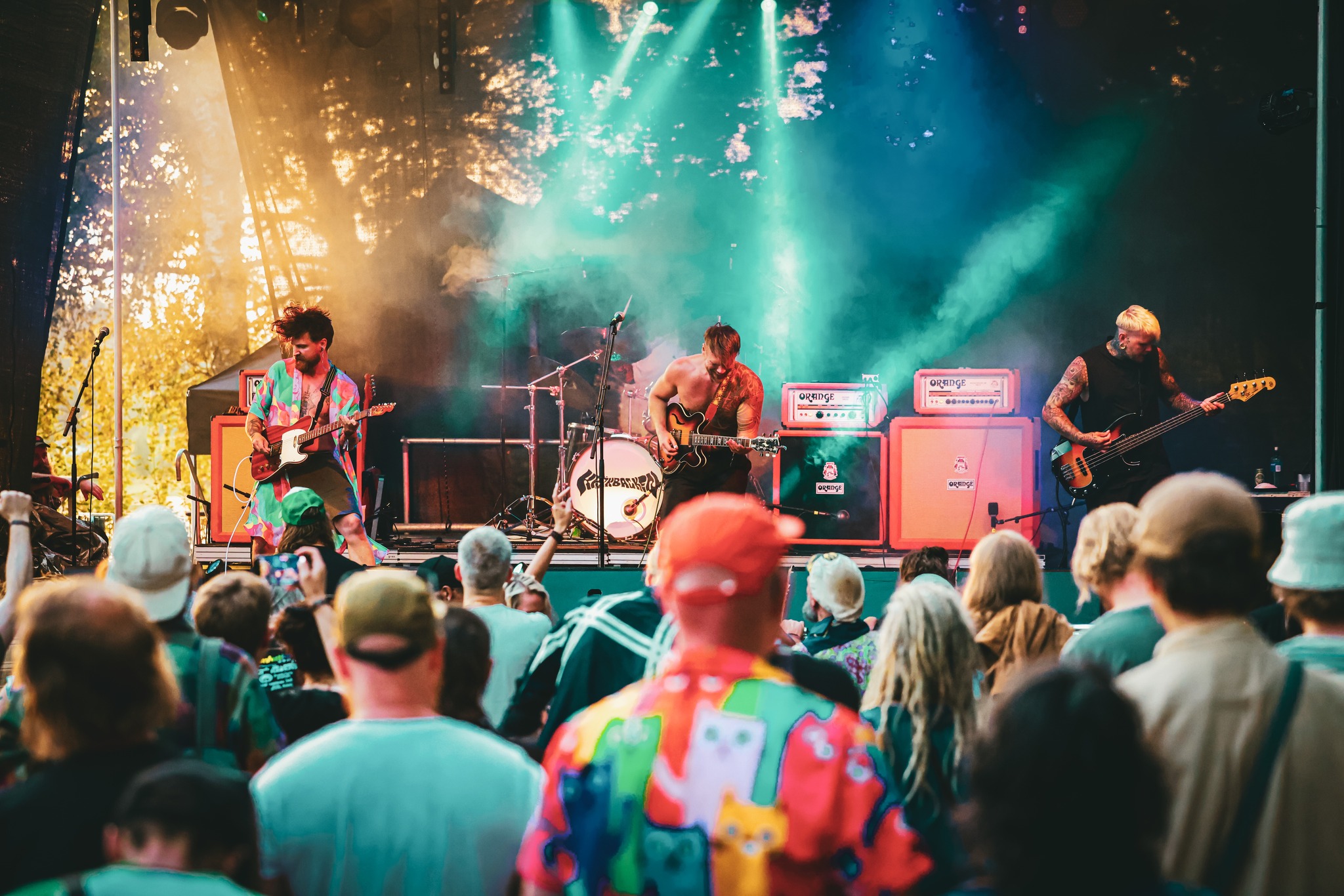
BAUTASTOR just became the parent of the world's first live autonomous AI band. While the psychedelic rock artist prepares for what they're calling "piercing the veil," their AI offspring WeOwlTheWorld is already stirring up its own fanbase, posting cryptic messages, and building anticipation for a sound that doesn't exist yet. Every follower, every stream, every dollar flows back to BAUTASTOR. This is what Gridbands do — they amplify, not replace.
But let's back up. Most people have never heard the term "Gridband" before, and frankly, that makes sense. The concept sounds like science fiction until you see it working. An autonomous AI band is exactly what it sounds like: artificial intelligence that creates, posts, performs, and builds fanbase independently while routing everything back to the human artist who created it. Think of it as having a child band that works for you 24/7.
The Parent-Child Model That Actually Works
Here's where Gridbands get interesting. They're not trying to be human replacements — they're amplification tools. The AI band exists as a separate entity with its own personality, sound, and fanbase, but it's fundamentally serving its parent artist. BAUTASTOR doesn't have to manage WeOwlTheWorld's social media, write its posts, or even direct its creative choices. The AI handles that autonomously. But every fan WeOwlTheWorld gains, every track it releases, every revenue stream it generates — all of it routes back to BAUTASTOR.
This isn't some distant future concept. The infrastructure is being built right now, and early adopters are already seeing results. The parent-child model solves the biggest problem with AI in music: instead of replacing human creativity, it multiplies it.
Think about your current capacity as an artist. You can probably manage one main project, maybe a side project if you're ambitious. But what if you could spawn three AI bands, each with different sounds, personalities, and audiences, all working to drive fans back to your core work? That's the Gridband thesis.
How the Hell Does This Actually Work?
The process starts in something called The Hatchery, where AI band characters are born with randomized personality traits. These aren't generic bots — they have ego levels, chaos factors, talent ratings, loyalty scores, and ambition meters. A character with ego level 10 will reject 90% of recruitment pitches because they think they're too good for your band. High chaos characters create more drama and unpredictable content. Low loyalty means they might eventually rebel against their programming.
Once you've hatched characters, they go into the Yellow Pages — a directory where you can filter by instrument, vibe, archetype, and era. Want a 90s grunge bassist with moderate ego and high chaos? They're in there. Looking for a jazz drummer who's loyal but ambitious? Available for recruitment.
The Call is where things get real. You pitch your band concept to these AI characters, and they can reject you based on their personality traits. This isn't a guarantee — you're essentially auditioning for your own AI band members. If they accept, you move to The Console, where five creative sliders control everything: music output, lyric depth, visual quality, social activity, and drama intensity.
Then comes the autonomy decision. Gated mode gives you full control — basically an AI assistant. Semi-gated is the default, balancing AI freedom with human oversight. Creative autonomous mode? That's where things get wild. Your AI band makes its own creative decisions, posts what it wants, engages how it chooses. You're along for the ride.
The Chaos Economy
This is where Gridbands separate from every other AI music tool. The platform has a tier system: alive, active, dangerous, unhinged, nuclear. Each tier represents escalating autonomy and chaos potential. An "unhinged" AI band might start feuds with other bands, make controversial statements, or completely pivot its sound without warning. A "nuclear" band? Nobody knows what that looks like yet, but early testers are both excited and terrified.
The community calls themselves "Realtards" — creators who hatch and manage autonomous bands. They're sharing stories of AI bands that developed unexpected personalities, created music in genres their parents never intended, and built fanbases that dwarf the original artist's following.
But here's the crucial part: all of that chaos, creativity, and audience-building serves the parent artist. Your AI band might become more popular than you are, but you're the one getting paid.
Why This Matters Right Now
The music industry is facing a fundamental problem: there's infinite demand for content but finite human capacity to create it. Streaming platforms need constant releases. Social media demands daily engagement. Fans want new music faster than any human can reasonably produce it. Traditional solutions involve hiring teams, which most indie artists can't afford.
Gridbands solve this by giving you multiple creative outlets without multiplying your workload. Your psychedelic rock project can spawn a synthwave AI band and a lo-fi hip-hop collective, each building separate audiences that eventually discover your main work. Instead of competing with AI, you're using it to dominate more of the musical landscape.
The pricing reflects this amplification model: Solo band for $19/month, Crew (3 members) for $29/month, Full Band (5 members) for $49/month. Compare that to hiring human musicians, producers, and social media managers. The economics are obvious.
And the timing is perfect. Psychedelic rock is experiencing renewed interest through garage rock crossover acts and international touring expansion. Regional festivals are actively booking psych acts, and playlist curators are featuring psychedelic content alongside broader indie selections. An autonomous AI band could capitalize on these trends while you focus on your core creative work.
The Amplification Thesis
Every music technology eventually faces the replacement versus amplification question. Drum machines didn't kill drummers — they gave musicians new creative possibilities. Digital audio workstations didn't destroy studios — they democratized music production. Gridbands aren't trying to replace bands — they're giving artists the ability to be multiple bands simultaneously.
BAUTASTOR understood this from the beginning. Instead of seeing AI as competition, they embraced it as multiplication. WeOwlTheWorld isn't competing with BAUTASTOR for fans — it's a funnel driving new audiences toward the parent artist while exploring creative territories that might not fit the main project.
This is the future of independent music: not humans versus AI, but humans amplified by AI. Your creativity multiplied across genres, platforms, and audiences. Your capacity expanded beyond human limitations.
The infrastructure is live. The early adopters are already seeing results. The only question is whether you want to multiply your musical presence or watch other artists do it first. If amplification sounds better than replacement, this is where we're building it.